



I have a confession to make. I didn’t think about grief much before Dad died. I supported friends and family as best I could but believed the information and messages out there and not much beyond.
Until I lost Dad and felt totally adrift and lost, with epic levels of exhaustion and losing my appetite and drive for life. Grief felt like a pass to a different life, not aware of the rules or how anything worked anymore.
So, I leant on what I knew. The Five Stages of Grief Model was one of them. And as the emotional waves and thoughts and physical sensations washed over and around me, I tried to tie them to what I’d heard.
But it was so confusing. Only after working with a grief counsellor and throwing myself into art did I realise how much of our grief preparation is based on outdated models.
So that’s something I’m looking to change here.
Why the Five Stages fall short
Grief and bereavement have traditionally been viewed through the Five Stages Model. It suggests a linear progression through five stages: denial, anger, bargaining, depression, and acceptance.
However, modern insights and scientific understanding reveal a more complex picture of grief as a non-linear and deeply individual process.
While the Five Stages Model provides structure, and much needed certainty, it often oversimplifies the multifaceted nature of grief. And it was created from Elisabeth Kubler-Ross’ work with people who were dying, not from research on bereaved people.
This is an important context difference, and it’s led to pressure landing on people in unhelpful ways.
Many of us don’t experience grief in a sequential order, leading to confusion and self-blame when our feelings and thoughts deviate from this path.
The expectation to progress neatly through stages crushes those of us already navigating the heavy burden of loss in a complicated or prolonged way.
I sometimes wonder how much of this outdated narrative around grief contributes to us hurting more deeply or for longer than needed.
It’s worth questioning the status quo.
Embracing the Dual Process Model of Grief
The Dual Process Model is a psychological framework created in 1999 by Margaret Stroebe and Henk Schut, showing how coping with bereavement isn’t linear but rather oscillates between two coping types:
1. Loss-Oriented Coping Mode: Direct engagement with the loss itself.
2. Restoration-Oriented Coping Mode: Adjusting to the life changes caused by the loss.
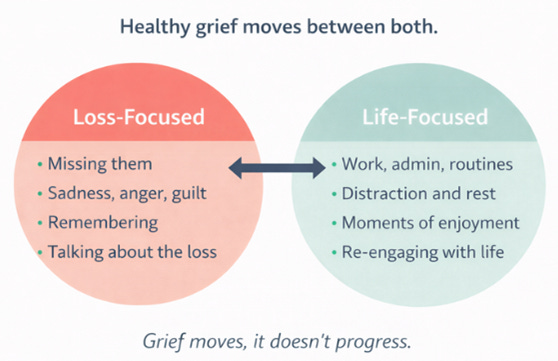
Their research suggests healthy bereavement adaptation involves moving back and forth between these two modes. It’s a more accurate picture of how we cope with grief.
I know my initial grief response was very loss focused and disconnected, drifting day to day but not attaching to anything. I felt guilty every day, questioning my thoughts and actions (“Am I bargaining when I wish he hadn’t died?”) and distracted by which stage I was in and why it didn’t quite fit.
Not long after, I looked up the differences between grief and depression because it felt so similar to my lowest depression periods, but also completely new. I was lost.
I also beat myself up when I could only muster a bit of focus on the probate process and dealing with his finances and estate. I delayed and delayed because it felt like I was ignoring his death if I focused on death admin.
It took a lot of effort to move into and stay in restoration or life-focused mode. But if I’d known about this moving back and forth concept being helpful back then, small steps into restoration would have felt like a win with less guilt.
This model recognises the fluid nature of grief, where emotions, feelings and energy fluctuate and coexist. So, by understanding that grief does not follow a linear path, we give ourselves the grace to feel what we feel fully without the constraints of a predetermined framework.
Feeling like we’re doing grief “wrong” layers on suffering when we’re already in pain.
Why your body needs both modes during grief
When Dad died, my body felt it instantly before my mind caught up.
Muscles and joints ached, my tummy was off, and I wanted to sleep all day but couldn’t rest properly. I disconnected, sluggish and couldn’t get going, wanting to shut down and ignore the world and this new reality.
My memory turned to sh*t. I left the gas hobs on for hours a few times. I thought I’d done things when I hadn’t. It was disorienting at best, scary as heck at worst.
I knew grief was stressful. But I didn’t realise it could feel this physical.
When you lose someone you love, your stress systems activate. The hypothalamic–pituitary–adrenal axis (HPA axis) releases cortisol and other hormones to help you respond to threat. That makes sense. Loss is a threat. It destabilises everything.
For many people, those systems stay more activated than usual for a while. Sleep becomes lighter or fragmented. Appetite shifts. Your immune system can dip. Concentration becomes unreliable. You might feel wired and anxious with a racing heart. Or flat and slowed down. Or both, at different times.
This isn’t weakness but a body reeling and trying to adapt to a world that’s fundamentally changed.
This isn’t “just grief.” This is your biology responding to a major disruption.
Here’s why the Dual Process Model works with your biology, not against it
When you’re stuck in loss-oriented mode 24/7, like crying, looking at photos, regretting every “wrong” decision, feeling the full weight of the loss, your stress response doesn’t get a break or a chance to settle.
The body doesn’t register relief and there’s no signal that it’s safe enough to pause.
But when you consciously move into restoration-oriented activities, like dealing with practical tasks, going for a walk, making dinner, sending one probate email, you’re giving yourself permission to shift.
Actions might still be stressful, but doing small, discrete tasks offers a beginning, middle, and end. That completion gives your system a different input.
Not “the loss is gone,” because it isn’t. It signals “I can still function and manage life tasks.” And that matters.
Your body is built for shifts. Periods of activation, followed by partial recovery. Grief throws that rhythm off its axis.
Moving deliberately between loss and life helps realign it.
You’re not avoiding grief. You’re reducing the load on a system that’s already stretched
Focusing on restoration-oriented activities isn’t avoiding grief. It’s making space for it. Because life does keep moving, even if we don’t want it to.
I felt guilty every time I focused on Dad’s finances, sending emails and death notifications to so many organisations. It felt like forcing myself to move away from what he meant to me, when I focused on his estate and admin issues.
But dealing with his estate wasn’t a distraction from grief. It was a way to regulate my stress response and take breaks from feeling the loss at such a raw, emotional level. And it’s not like we don’t still cry when we’re dealing with death admin.
Nostalgic waves wash over us, we get lost in the “what ifs” but we return to a task that moves us forward, even if it’s just an inch.
This is why my coaching work starts with the body: sleep nutrition, movement, hydration. When your HPA axis and body are dysregulated, you don’t always have the energy for deep emotional processing.
And that’s OK because you’re in survival mode. But helping body basics creates the conditions to do that in a healthier, more sustainable way.
The Dual Process Model isn’t just a psychological framework but offers a way to actively manage your stress physiology and function. Oscillating between loss-focus and life-focus isn’t weakness. It’s regulation.
It’s your body’s way of coping with something that otherwise overwhelms your biological systems completely.
The benefits of a non-linear approach
Your body is built for movement, for shifts away from and back toward baseline. That’s how it adapts to change.
The Dual Process Model works because it works with how your stress response functions, not because it follows some therapeutic ideal.
Loss-oriented and restoration-oriented modes aren’t stages to complete. They’re states your nervous system and mind can move between to feel steadier over time.
And if you’ve felt off for a while, you’re not failing and you’re not behind. Your biology is doing what it evolved to do, which is helping you survive loss whilst continuing to function in a world you wish would stop but won’t.
The day I finally filled in one probate form and then went for a short walk without apologising to Dad in my head, that was oscillation.
Not progress through a stage or guilt about doing something. Just movement.
And that’s enough.
P.S. If you're curious about exploring your grief in a more flexible way, check out my self-guided workshop Navigating Grief With Compassion. I have a section with a fillable template about the Dual Process Model to try yourself.